
Is a Stone Chip Driveway Right for Your Property?
A chip stone driveway is a driveway made from layers of compacted crushed stone, topped with smaller, angular chips. Unlike tar and chip, it has no asphalt binder. It offers a natural look and lets water drain through, but the loose surface needs occasional raking and fresh stone.
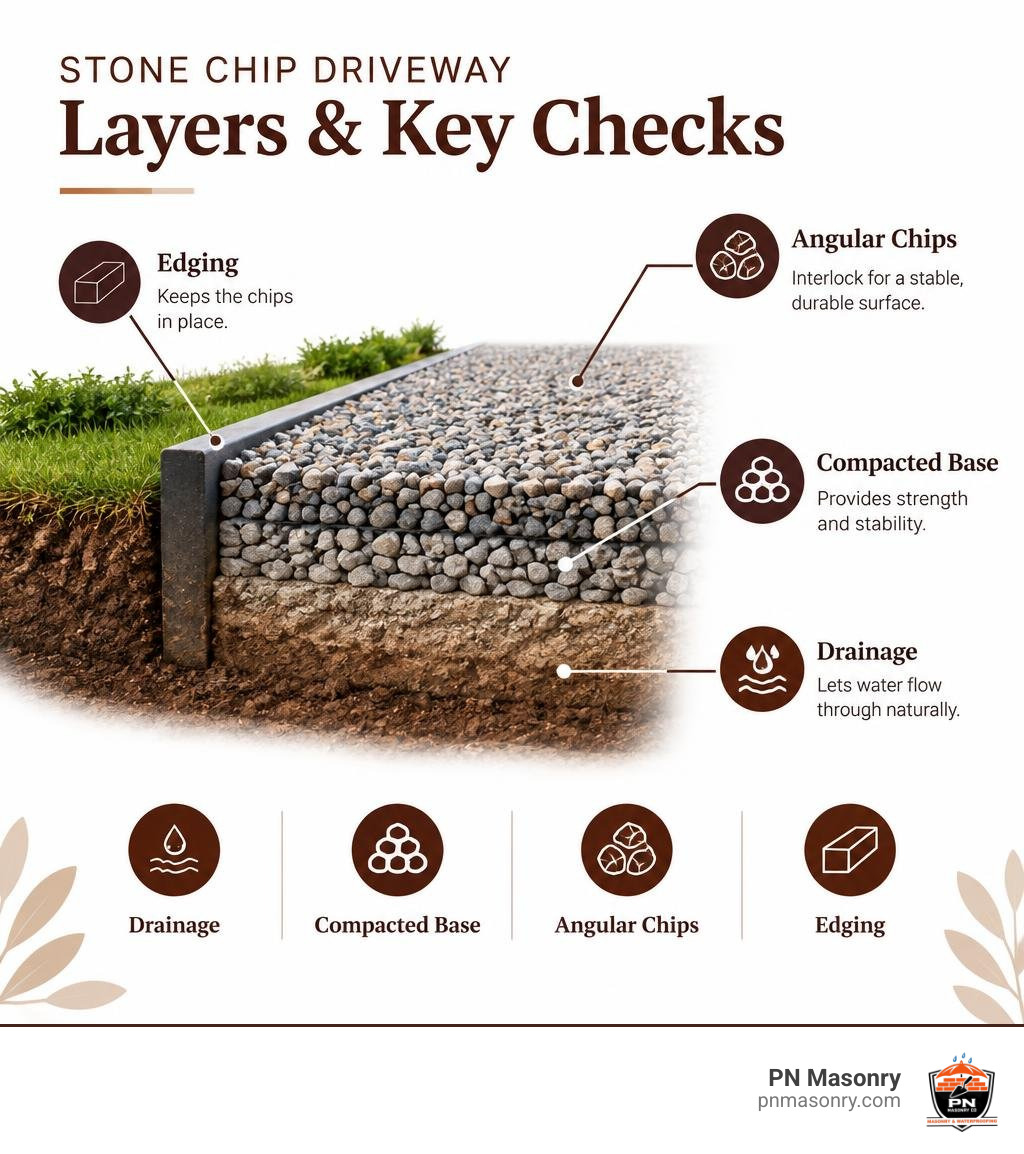
Before installing one, check that your site can drain well. A firm, compacted base and edging to hold the chips in place matter more than the stone color. For a Cook County property, also plan how you will clear snow without scraping up the surface.
Related content about chip stone driveway:
What Is a Chip Stone Driveway and How Does It Work?
A chip stone driveway relies on mechanical physics rather than chemical binders like Portland cement or petroleum bitumen. When vehicles drive over loose, rounded stones (like river pea gravel), the round stones roll out of the way like ball bearings, causing tire sinkage and deep ruts.
In contrast, stone chippings are mechanically crushed to create sharp, angular edges with multiple flat facets. When heavy machinery compacts these angular stones over a rigid sub-base, the facets lock together like pieces of a puzzle. As vehicle weight passes over the surface, the downward pressure pushes these angular stones tighter into one another, distributing wheel loads across the entire footprint while preserving void spaces that allow stormwater to percolate naturally into the ground.
Stone Chip vs Tar and Chip vs Traditional Gravel
Homeowners often confuse three common aggregate driveway systems: pure stone chip, tar and chip (chip seal), and traditional loose gravel. Understanding their engineering differences ensures you choose the right surface for your property:
- Chip Stone Driveway: Built purely with compacted, graded, angular aggregates over a non-woven geotextile membrane and structural sub-base. It is completely permeable, contains no petroleum binders, stays cooler in the summer, and requires occasional raking. Learn more about the mechanics in this guide to chip stone driveway construction.
- Tar and Chip (Chip Seal): Liquid hot asphalt emulsion is sprayed across a prepared base, covered with aggregate chips, and compacted with a rubber-tired roller. The liquid asphalt locks the lower portion of the aggregate in place while adding only 3/8 inch in height to the roadway. It lasts about a decade with minimal maintenance and provides high skid resistance, but is impermeable compared to loose stone.
- Traditional Gravel: Typically consists of unsorted, rounded stones or pit-run gravel with high dirt content. It tends to shift heavily under tires, creates significant dust clouds in dry months, and washes out during intense downpours.

Structural Layer Anatomy
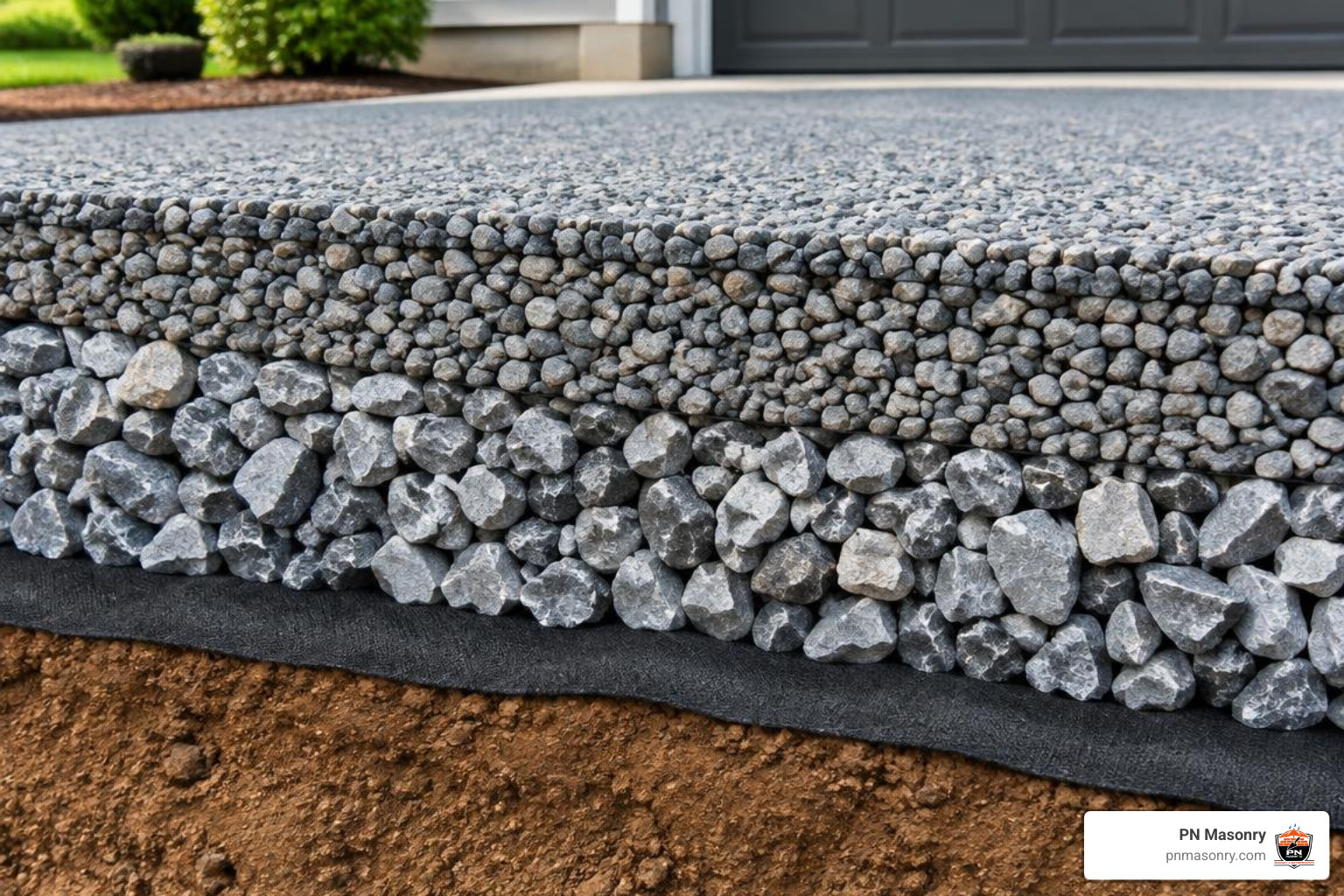
A durable chip stone driveway relies on a multi-tiered foundation to prevent sinking, shifting, and frost heave:
- Subgrade Soil: The native dirt excavated 8 to 10 inches below grade, sloped with a 1–2% crown to shed water, and compacted to eliminate soft spots.
- Geotextile Membrane: A commercial-grade, heavy non-woven geotextile fabric laid directly over the native subgrade. This layer prevents sub-base stones from sinking into the subsoil while stopping underground mud from pumping up into your clean stone layers.
- Sub-Base Layer (4 to 6 inches): Coarse, crushed stone (such as MOT Type 1, crushed concrete, or 1.5-inch angular limestone) compacted in mechanical lifts to create an unyielding platform.
- Base Layer (2 to 3 inches): Medium-grade angular aggregate (such as 3/4-inch crushed granite or limestone) leveled and rolled to distribute vehicle loads.
- Wearing Surface (1.5 to 2 inches / ~50mm): The decorative, angular 14–20mm stone chippings. Keeping this layer around 50mm deep ensures a smooth roll for car tires without creating excessive stone displacement.
Evaluating the Pros, Cons, and Material Options
Choosing the right aggregate type dictates your driveway’s aesthetic style, structural durability, and maintenance needs.
- Granite Chips: Extremely hard, durable, and weather-resistant with sharp fracture points. Available in gray, pink, and silver tones, granite resists vehicle crush and keeps its color indefinitely.
- Limestone Chippings: A classic, cost-effective choice featuring crisp white, buff, or charcoal hues. Angular limestone locks together exceptionally well under vehicle compaction, though softer grades can generate fine dust over many years. Regional favorites like Purbeck Chippings offer timeless rustic appeal.
- Basalt and Trap Rock: Dense volcanic rocks featuring dark charcoal or blue-gray coloring. Trap rock is exceptionally heavy, tough against freeze-thaw cycles, and provides superb tire traction.
- Recycled Concrete Aggregate (RCA): An eco-friendly base option made of crushed reclaimed concrete that compacts into an ultra-stiff foundation at a lower material cost.
Key Benefits of a Chip Stone Driveway
A well-constructed chip stone driveway provides several unique functional and visual advantages:
- Rapid Permeability and Drainage: Water passes directly through the void spaces between angular stones, eliminating surface pooling, sheet runoff, and localized flooding without requiring complex underground storm drains.
- Superior Summer Heat Reflection: Lighter-toned stones like granite and buff limestone reflect solar radiation, keeping your driveway surface significantly cooler than heat-absorbing black asphalt.
- Auditory Property Security: The distinct, satisfying “crunch” of tires or footsteps over stone chips serves as a natural audible alert whenever someone approaches your home.
- Freeze-Thaw Flexibility: Because the stone structure is unbonded, it naturally expands and contracts during Midwest winter freeze-thaw cycles without developing structural cracks.
- Elevated Curb Appeal: You can tailor the aggregate tone to match your home’s exterior cladding, brickwork, or architectural accents. Explore how different aggregates improve aesthetics in this driveway chippings curb appeal guide.
Drawbacks, Maintenance Realities, and Edging Solutions
While stone chip surfaces offer great benefits, they do require hands-on upkeep compared to solid masonry or concrete:
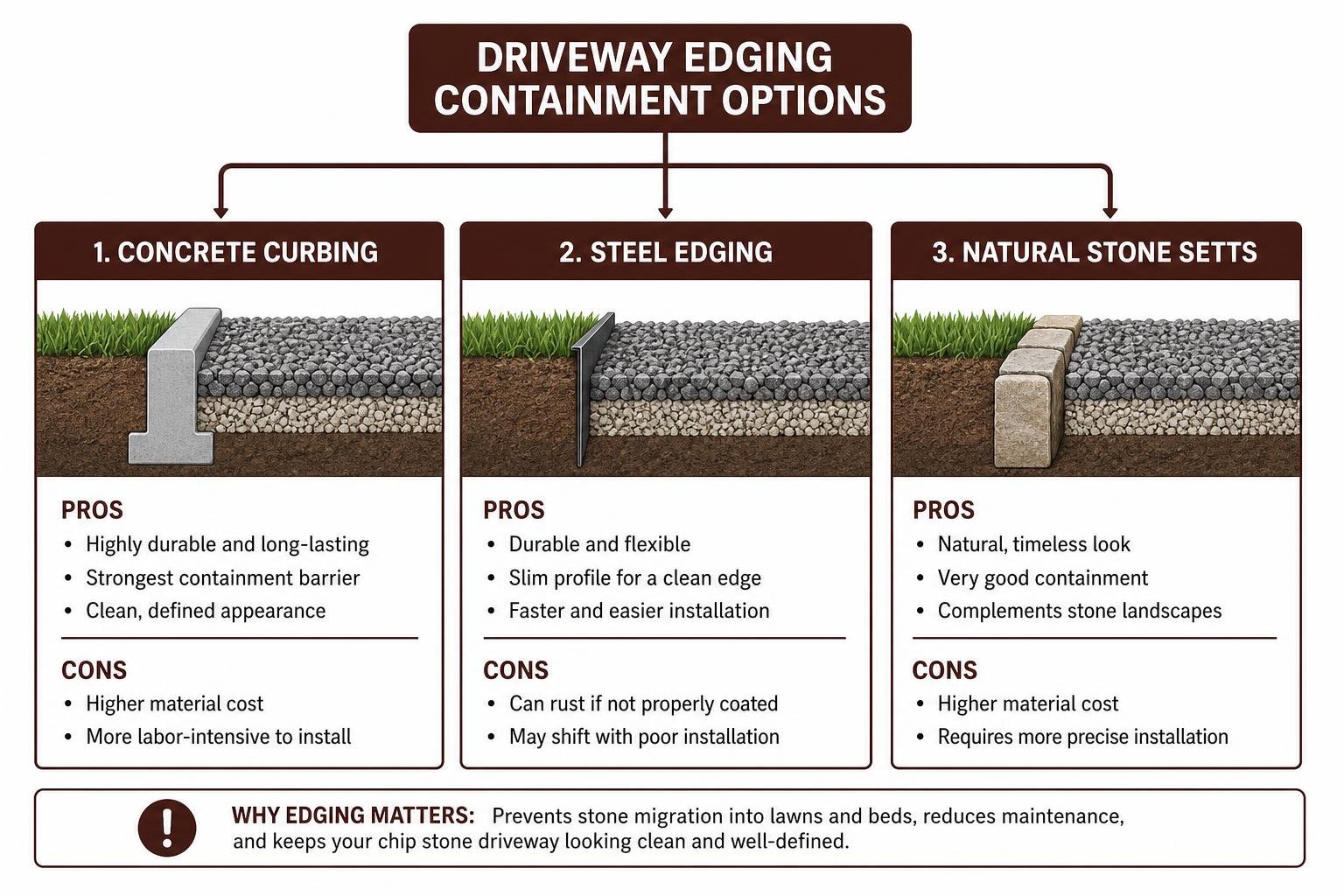
- Stone Migration and Edge Spreading: Without a solid perimeter barrier, stone chips will wander into adjacent lawns, flower beds, and walkways. Installing robust containment borders—such as concrete curbing, heavy-gauge steel edging, or natural stone setts—is essential to keep chips locked in place.
- Periodic Maintenance: High-turn areas (like parking bays and turning circles) experience stone displacement and require occasional raking to redistribute the surface evenly.
- Dust Accumulation: Dry summer months can stir up aggregate dust if non-washed stones are installed. Opting for washed chip aggregates minimizes this issue.
If you are pairing a new driveway with exterior home upgrades, matching your stone border with complementary stone veneer installation replacement or custom masonry walls creates a seamless, high-end landscape presentation.
Professional Installation Steps and Best Practices
Installing a long-lasting chip stone driveway requires disciplined earthwork and layering. Here is how we build durable aggregate driveways that stand the test of time.

Ground Preparation and Base Compaction
- Site Layout and Excavation: Clear all turf, roots, and organic topsoil. Excavate the driveway footprint to a total depth of 8 to 10 inches below final finished grade, creating a slight center crown (1/4 inch per foot of width) to guide subsurface water toward the edges.
- Subgrade Compaction: Run a heavy reversible plate compactor or vibratory roller over the bare native soil to identify and eliminate soft spots.
- Geotextile Installation: Roll out heavy non-woven geotextile fabric across the excavated subgrade, overlapping all seams by at least 12 inches to prevent soil intermixing.
- Sub-Base Placement: Spread 4 to 6 inches of coarse, angular aggregate (such as MOT Type 1 crushed stone). Compact the material thoroughly in 2- to 3-inch lifts using a heavy vibratory roller, spraying light water misting to achieve optimum compaction density.
Aggregate Placement, Raking, and Edge Containment
- Edging Installation: Secure rigid perimeter restraints—such as granite cobblestones, Belgian block set in a wet mortar bed, or heavy-gauge steel edging pinned with steel stakes—along the perimeter. The top of the edging should sit 1 to 1.5 inches above the finished stone layer.
- Base Layer Grading: Place a 2- to 3-inch leveling course of 3/4-inch crushed stone aggregate over the sub-base, grading it smooth to match the crown profile.
- Wearing Course Application: Spread angular 14–20mm stone chippings evenly across the base to a uniform depth of 1.5 to 2 inches (50mm). Applying stone any thicker than 2 inches can cause tires to bog down.
- Final Seating and Smoothing: Level the chips with wide landscape rakes and make a light, single pass with a smooth roller to settle the stones into their mechanical interlock.
Total Project Costs and Material Comparisons
Evaluating driveway materials involves weighing upfront investment against long-term maintenance and longevity.
| Driveway Material | Average Cost (Installed per Sq Ft) | Typical Lifespan | Maintenance Level | Permeability |
|---|---|---|---|---|
| Chip Stone | $4.00 – $15.00 | 15–30+ Years (Indefinite with stone top-ups) | Low–Moderate (Periodic raking & top-ups) | 100% Permeable |
| Tar and Chip | $3.50 – $7.00 | 8–12 Years | Low (Occasional sweeping/resealing) | Semi-Permeable to Impermeable |
| Standard Asphalt | $7.00 – $13.00 | 15–20 Years | Moderate (Sealcoating every 2–3 yrs) | Impermeable |
| Poured Concrete | $9.00 – $18.00 | 25–40 Years | Low–Moderate (Joint sealing & crack repair) | Impermeable |
| Traditional Gravel | $2.00 – $5.00 | 5–10 Years | High (Frequent grading & weed pulling) | Moderately Permeable |
For homeowners evaluating concrete alternatives, consulting an experienced concrete contractor Franklin Park IL can help assess whether solid masonry or permeable aggregate best suits your soil and slope conditions.
Estimated Chip Stone Driveway Costs and Pricing Factors
The total project investment for a chip stone driveway depends on size, site grading, and material quality:
- Small Driveways (150–200 sq ft): Typically range between $2,500 and $4,500 for standard crushed stone and simple border edging.
- Medium Driveways (300–500 sq ft): Typically run $4,500 to $8,000, including full-width Belgian block edging and minor drainage contouring.
- Large Estates (600–800+ sq ft): Range from $8,000 to $12,000+, incorporating reinforced 6-inch sub-bases, premium granite chippings, and commercial stone containment.
Major variables shaping project quotes include:
- Material Costs: Raw aggregate chippings range from $0.25 to $1.50 per pound depending on stone variety and quarry proximity.
- Base Preparation: Excavation, subgrade grading, and aggregate base installation typically cost between $0.50 and $3.50 per square foot.
- Containment Edging: Border options range from $100 for basic timber to $1,200+ for mortar-set cobblestones.
- Drainage and Grading: Correcting site slopes or installing french drains can add $300 to $3,000 to project totals.
- Labor Rates: Crew labor generally ranges from $1,000 to $6,000 based on site access, project complexity, and local labor rates.
For a deeper dive into regional pricing dynamics, review this detailed breakdown of U.S. chip stone driveway costs.
Longevity and Maintenance Investment
One ton of 20mm stone chippings covers roughly 14 square meters (~150 sq ft) at an optimal 50mm depth. Because crushed mineral aggregate never rots or degrades under UV rays, a properly built stone chip driveway can last indefinitely. To maintain peak performance:
- Rake High-Traffic Zones: Spend 10 minutes every few months raking displaced stones back into central drive lanes.
- Top-Up Stones (Every 1–3 Years): Add a light dusting of fresh chips (1/2 to 1 ton) to refresh color and replenish stones carried away on tire treads.
- Maintain Neighboring Masonry: Protect adjoining retaining walls and masonry features by scheduling professional concrete sealing Franklin Park IL to prevent water absorption and efflorescence.
Critical Mistakes to Avoid and Climate Considerations
Building a durable aggregate driveway requires avoiding key installation mistakes that can lead to rutting and drainage failures.
Common Installation and Maintenance Pitfalls
- Skipping the Geotextile Fabric: Omitting the separation membrane allows the sub-base rock to sink into wet subsoil, resulting in deep tire ruts within months.
- Using Rounded River Pea Gravel: Round stones cannot interlock under vehicle weight. Always specify angular, crushed chips (14–20mm).
- Overfilling the Surface Layer: Spreading surface stones deeper than 2 inches creates a “beach sand” effect that bogs down tires and makes walking difficult.
- Installing Inadequate Edging: Neglecting rigid edge restraints leads to aggregate spreading into surrounding grass, creating lawnmower hazards.
- Improper Snow Removal: Setting snow plow blades flush against stone chips will scrape your driveway aggregate directly onto the lawn. Always install rubber-tipped plow blades or raise skid shoes 1 to 1.5 inches above the surface.
For homes with adjacent masonry footings, coordinating brick block sealing waterproofing ensures that runoff from permeable driveways does not seep into foundation masonry.
Climate Performance and Slope Suitability
Stone chip surfaces handle cold winter regions and summer heat waves exceptionally well:
- Freeze-Thaw Durability: Rigid concrete can crack when the ground freezes and heaves. A flexible, permeable chip stone driveway moves naturally with the freeze-thaw cycle and settles back into place without structural damage.
- Slope Limitations: Stone chip driveways perform best on flat terrain or gentle grades (under 8% slope). On steep hills, heavy torrential rains can wash loose stones downhill, making asphalt or stepped stone paving a better fit.
- Tight Turning Radii: In tight parking aprons where drivers turn wheels while stationary, aggregate can form shallow divots over time. Choosing heavier, angular aggregates like 20mm trap rock or basalt provides maximum resistance against tire shear.
Frequently Asked Questions About Stone Chip Driveways
How often does a stone chip driveway require fresh aggregate?
Most residential stone chip driveways benefit from a light aggregate top-up every 1 to 3 years. Over time, heavy traffic can push surface chips deeper into the base voids or carry small amounts away on tire treads. Adding a thin 1/2-inch layer of fresh, washed chips quickly restores optimal depth and vibrant color.
Can you plow snow on a chip stone surface without damaging it?
Yes, but you must take precautions during winter plowing. Raise the plow blade by adjusting the skid shoes 1 to 1.5 inches above the stone surface, or use a plow equipped with a protective polyurethane cutting edge. For light to moderate snowfalls, snow blowers with raised skid shoes or manual shovels with plastic blades keep your stone surface intact.
Is geotextile fabric necessary under a stone chip driveway?
Geotextile fabric is critical for long-term structural integrity. Without a heavy non-woven geotextile membrane separating the native soil from the aggregate base, the heavy stone layers will gradually sink into the dirt under vehicle weight, causing surface dips, wheel ruts, and weed growth.
Conclusion
A chip stone driveway combines the timeless charm of estate-style aggregate with modern engineering, natural stormwater drainage, and superior summer heat reflection. By investing in proper excavation, a solid compacted sub-base, heavy-duty geotextile fabric, and secure perimeter edging, you can create a driveway that enhances your property’s curb appeal for decades.
At PN Masonry, our team brings expert masonry craftsmanship and site preparation expertise to every residential and commercial project in Cook County, Illinois. Whether you are building an aggregate driveway border, upgrading stone retaining walls, or planning custom exterior masonry, explore our completed masonry project gallery for design inspiration, or contact our expert masonry contractor team today to schedule your on-site consultation.