
Choose the Right Chimney Waterproofing Products Before Water Damage Spreads
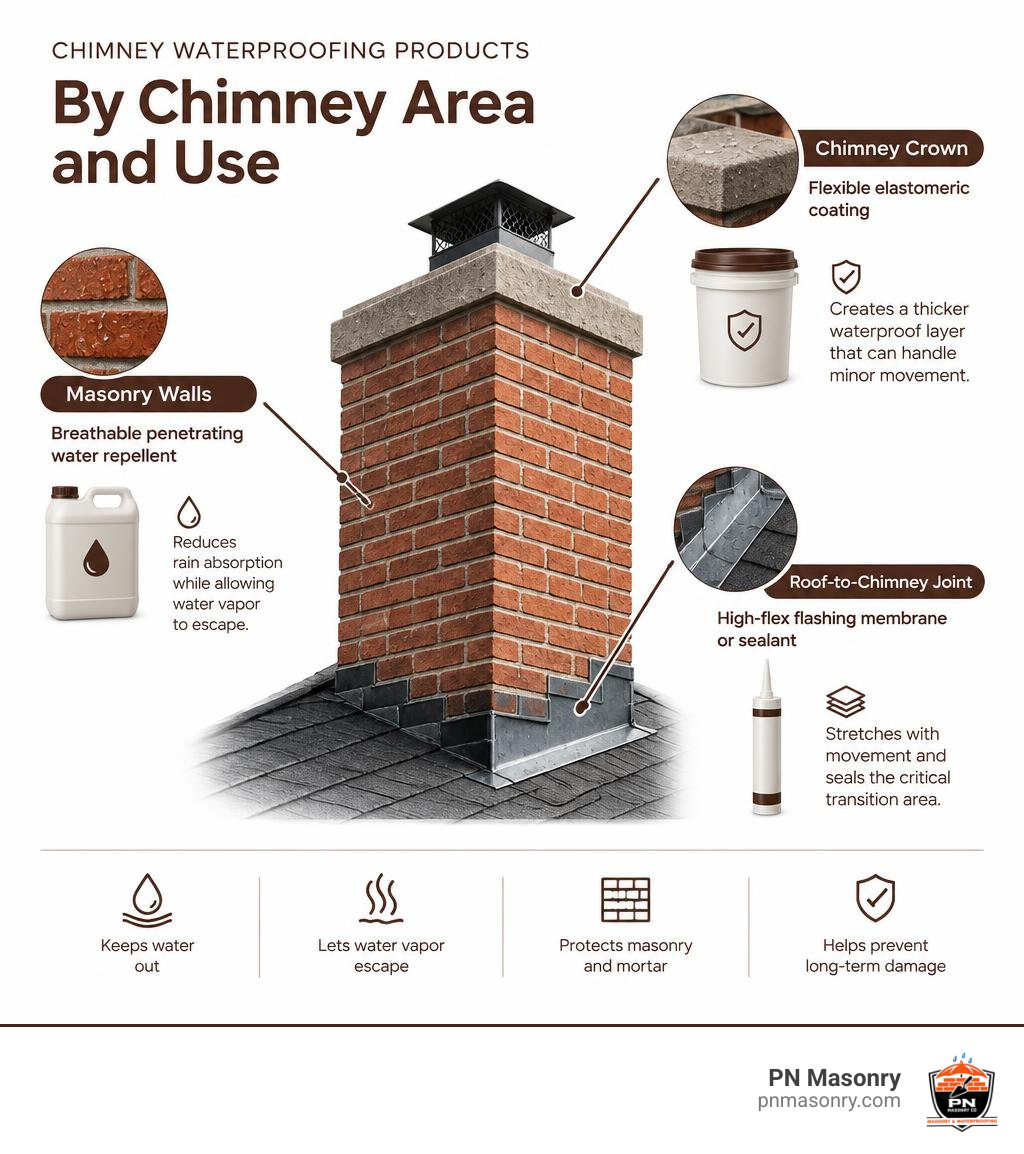
The best chimney waterproofing products depend on where the leak begins:
- Use a breathable penetrating water repellent for brick and block. It reduces rain absorption while allowing water vapor to escape.
- Use a flexible elastomeric coating on a cracked or worn chimney crown. It creates a thicker waterproof layer that can handle minor movement.
- Use a high-flex flashing membrane or sealant at the roof-to-chimney joint, where metal, masonry, and roofing meet.
This matters in Cook County. Water can enter through porous brick, open mortar joints, cracked crowns, and failed flashing. Once moisture freezes, it expands inside the masonry. That cycle can cause spalling brick, loose mortar, staining, and larger leaks.
A waterproofing product is not a substitute for repair. Cracked mortar, damaged brick, and loose flashing should be fixed first. Then the right sealer or coating helps protect the sound surface from future water intrusion.
In this guide, we review top options for chimney crowns, masonry walls, and flashing, including coverage, cure time, flexibility, VOC content, and warranty terms.
Types of Chimney Waterproofing Products and How They Work
Chimneys endure some of the harshest exposure of any building component. Perched high above the roofline, they face driving rain, intense UV radiation, and severe freeze-thaw cycles. Choosing the wrong barrier material can cause rapid deterioration. In masonry maintenance, one rule is paramount: liquid water must stay out, but trapped water vapor must be allowed to escape.
Standard exterior paints or silicone coatings form an impermeable film over porous surfaces. While this might sound protective, it acts like wrapping wet brickwork in plastic wrap. When internal moisture rises from your fireplace or migrates from living spaces, it hits this non-breathable barrier, gets trapped, and freezes during winter. The resulting expansion pops the faces off your brick—a destructive failure known as spalling.
Modern masonry care relies on three distinct chemical formulations, each designed for specific parts of the chimney assembly:
- Breathable Penetrating Repellents: Modified siloxane and silane compounds that bond inside the pores of vertical brick, concrete block, and mortar.
- Elastomeric Crown Coatings: Heavy-bodied polymer emulsions designed to bridge surface fractures and seal horizontal chimney slabs without breaking when the structure shifts.
- Hybrid Flashing Sealers & Cold-Applied Membranes: High-elongation moisture-cure polymers and rubberized asphalt emulsions that bond dissimilar materials (like sheet metal, lead, shingles, and brick).
For comprehensive protection across all surfaces, professional brick and block sealing and waterproofing matches the chemistry of the sealant directly to the porosity and structural demands of the substrate.
Penetrating Sealers vs. Surface Chimney Waterproofing Products
The functional difference between a penetrating water repellent and a surface-forming film coating comes down to molecular behavior:
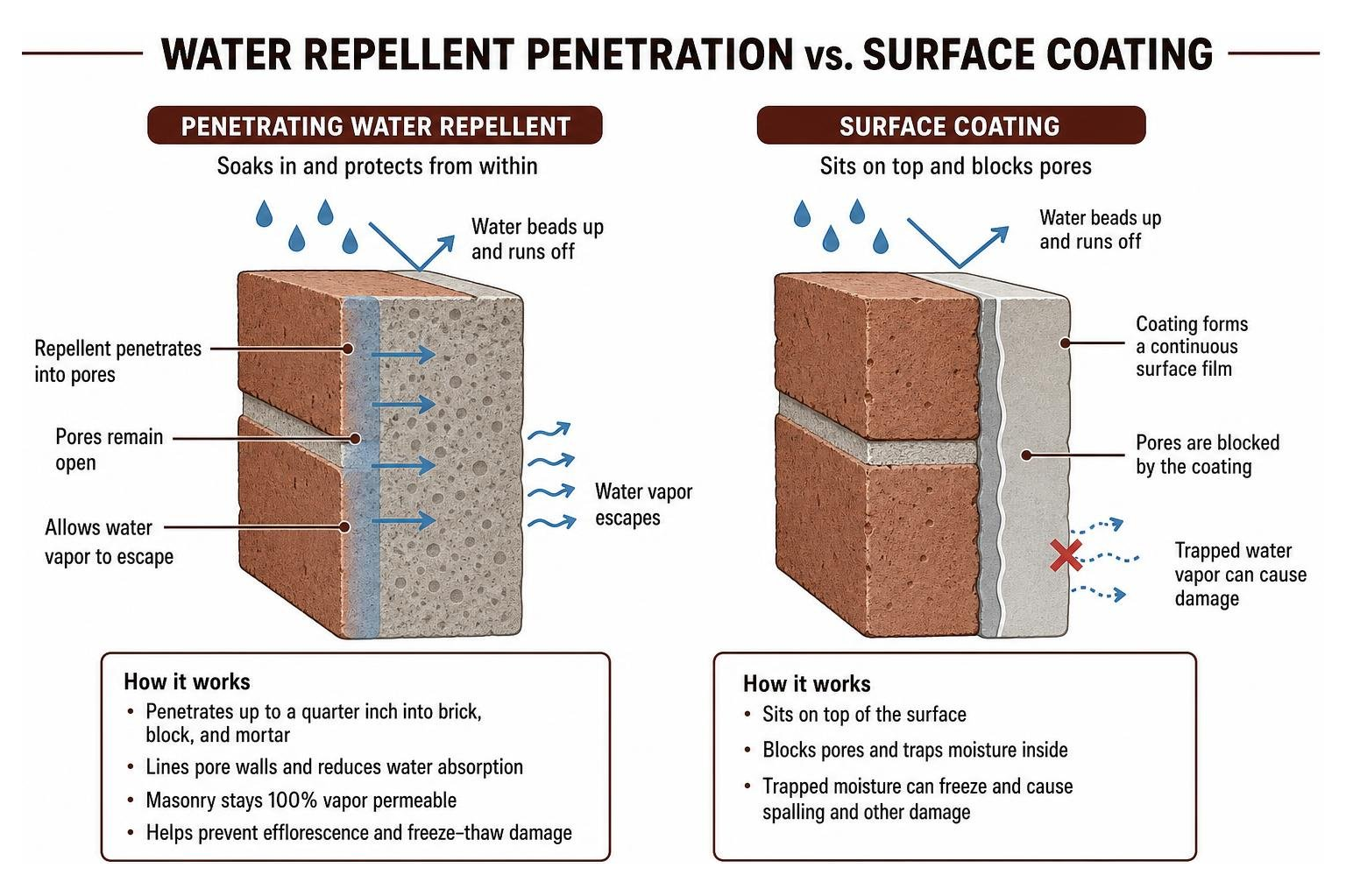
A water-based modified siloxane repellent penetrates up to a quarter of an inch deep into brick, block, and mortar joints. Instead of plugging the pore structure, the siloxane molecules line the capillary walls. This chemical alteration changes the surface tension, causing liquid water droplets to bead up and run off the vertical surface rather than soaking into the clay or aggregate.
Because the microscopic pores remain open, the treated masonry stays 100% vapor permeable. Any moisture existing inside the brick structure evaporates safely into the atmosphere. Many premium siloxane formulas are UV-activated: sun exposure actually strengthens their chemical bond inside the substrate over time rather than breaking it down. Siloxane treatments provide coverage of approximately 125 sq. ft. per gallon and typically include a 10-year warranty against water intrusion, effectively preventing efflorescence (white mineral salt staining) and freeze-thaw damage.
Elastomeric Coatings and Flashing Membranes
Horizontal chimney crowns and roof-to-chimney joints encounter ponding water and dramatic thermal expansion. Simple penetrating repellents cannot span structural gaps or withstand standing water on flat crown surfaces. These vulnerable areas require thick, flexible elastomeric barriers.
High-performance elastomeric coatings and flashing products feature extreme flexibility:
- Elongation: Exceeding 500% under ASTM D412 testing, allowing the material to stretch and recover as metal flashing and brick expand at different rates.
- Tensile Strength: Reaching 170 psi to resist tearing during thermal movement.
- Crack Bridging: Meeting ASTM C1305 standards to span active cracks from 1/8″ up to 1/4″ wide.
- Hydrostatic Pressure Resistance: Withstanding up to 100 psi under ASTM D5385 hydrostatic barrier ratings.
When cold-applied elastomeric membranes or solvent dampproofing mastics are integrated into transition details, they provide a seamless barrier that outlasts typical roofing tar. When metal components degrade or step flashings corrode, pair high-performance membranes with our expert chimney flashing repair to resolve leak paths at the roof deck.
Top Waterproofing Solutions for Crowns, Masonry, and Flashing
Selecting the right product requires evaluating coverage rates, VOC compliance (especially under strict regional environmental standards), application thickness, and manufacturer guarantees.
| Product / Technology | Primary Application Area | Applied Thickness | Approximate Coverage | VOC Level | Warranty Length |
|---|---|---|---|---|---|
| Flexible Elastomeric Crown Coating | Chimney Crowns, Parapets | 1/8″ to 1/4″ | 14–18 sq. ft./gal (1/8″) 7–9 sq. ft./gal (1/4″) |
30 g/L | 10 Years (Residential) |
| Penetrating Siloxane Repellent | Brick, Stone, Mortar Joints | Deep Penetration (No film) | ~125 sq. ft./gal | Low VOC Compliant | 10 Years |
| Hybrid Moisture-Cure Membrane | Flashings, Roof Transitions | 30–45 mils | 30–50 sq. ft./gal | < 45 g/L | Lifetime (Contractor-applied) |
| High-Elongation Fluid Membrane | Masonry Shafts, Parapets | Fluid-applied membrane | Varies by substrate | Low VOC | Manufacturer Standard |
| Solvent Asphalt Dampproofing Mastic | Below-grade & Cavity Walls | 1/16″ to 1/8″ wet film | 20–100 sq. ft./2 gal (by grade) | 193–237 g/L | Industrial Standard |
When applying heavy-bodied crown coatings, professional contractors rely on professional chimney crown repair to ensure structural cracks are stabilized before the final membrane is laid down.
Best for Chimney Crowns: Flexible Elastomeric Coatings
For horizontal chimney crowns, our top recommendation is a flexible elastomeric waterproof coating. This specialized polymer compound forms an unbroken, rubber-like membrane that mimics the natural color and texture of a freshly poured concrete cap.

Key technical and practical highlights include:
- Weathering Resistance: Demonstrates zero deterioration, cracking, or shrinkage after 5,000 hours of accelerated weathering under ASTM G53 testing.
- Application Profile: Applied at a thickness of 1/8″ (yielding 14–18 sq. ft. per gallon) to 1/4″ (7–9 sq. ft. per gallon). A standard 2-gallon pail covers roughly 36 sq. ft., while a 5-gallon container protects up to 90 sq. ft.
- Low VOC Formulation: Emits only 30 g/L VOC (EPA Method 24), making it environmentally safe and non-hazardous under DOT shipping classifications.
- Multi-Purpose Utility: Functions as both a surface membrane and a bonding mortar for small repairs. It can be tinted with standard mortar dye to match existing masonry colors.
- Warranty: Carries a 10-year transferable residential warranty when applied by a qualified contractor.
Best for Masonry Brick and Block: Breathable Siloxane Sealants
For vertical brick walls, stone chimneys, and concrete block structures, penetrating water repellents based on modified siloxanes deliver the best protection. Unlike clear film-forming sealers that yellow, peel, and trap moisture, siloxane treatments sink deep into the masonry matrix.
Because it does not alter the appearance or texture of the masonry, a breathable siloxane protects historic brickwork without imparting an artificial gloss. It chemically cross-links within the mineral components of clay and mortar. When winter temperatures drop, moisture cannot dwell near the surface of the brick, eliminating the expansion stresses that lead to spalling. With coverage running around 125 sq. ft. per gallon, siloxane treatments provide long-term protection backed by a 10-year warranty.
Best for Roof Transitions: Hybrid Moisture-Cure Flashing Sealers
Roof flashings represent the most vulnerable transition on any residential chimney. Metal flashing expands rapidly in the summer sun, while adjacent brick expands much more slowly. This rate difference tears conventional asphalt roof cements, opening gaps for water leaks.
Hybrid moisture-cure elastomeric systems resolve this problem:
- Rain-Safe Formulation: Becomes rain-safe in as little as 5 minutes, preventing wash-off from unexpected storms during application.
- Solvent-Free & Low VOC: Formulated with 100% solids and containing less than 45 g/L VOCs, it will not shrink or outgas as it cures.
- High Elasticity: Maintains flexibility across extreme temperatures ranging from -40°F up to 180°F.
- Coverage & Cure: One gallon seals 30 to 50 sq. ft. It reaches a tack-free state in 2 to 4 hours and achieves full cure within 24 to 48 hours.
- Professional Lifetime Warranty: Backed by an installation lifetime warranty when installed by a professional contractor to manufacturer specifications.
Step-by-Step Surface Preparation and Application Process
Applying waterproof coatings over dirty, crumbling, or structurally compromised masonry will result in premature failure. Even the most advanced elastomeric membrane cannot adhere to loose mortar, moss, or friable brick.
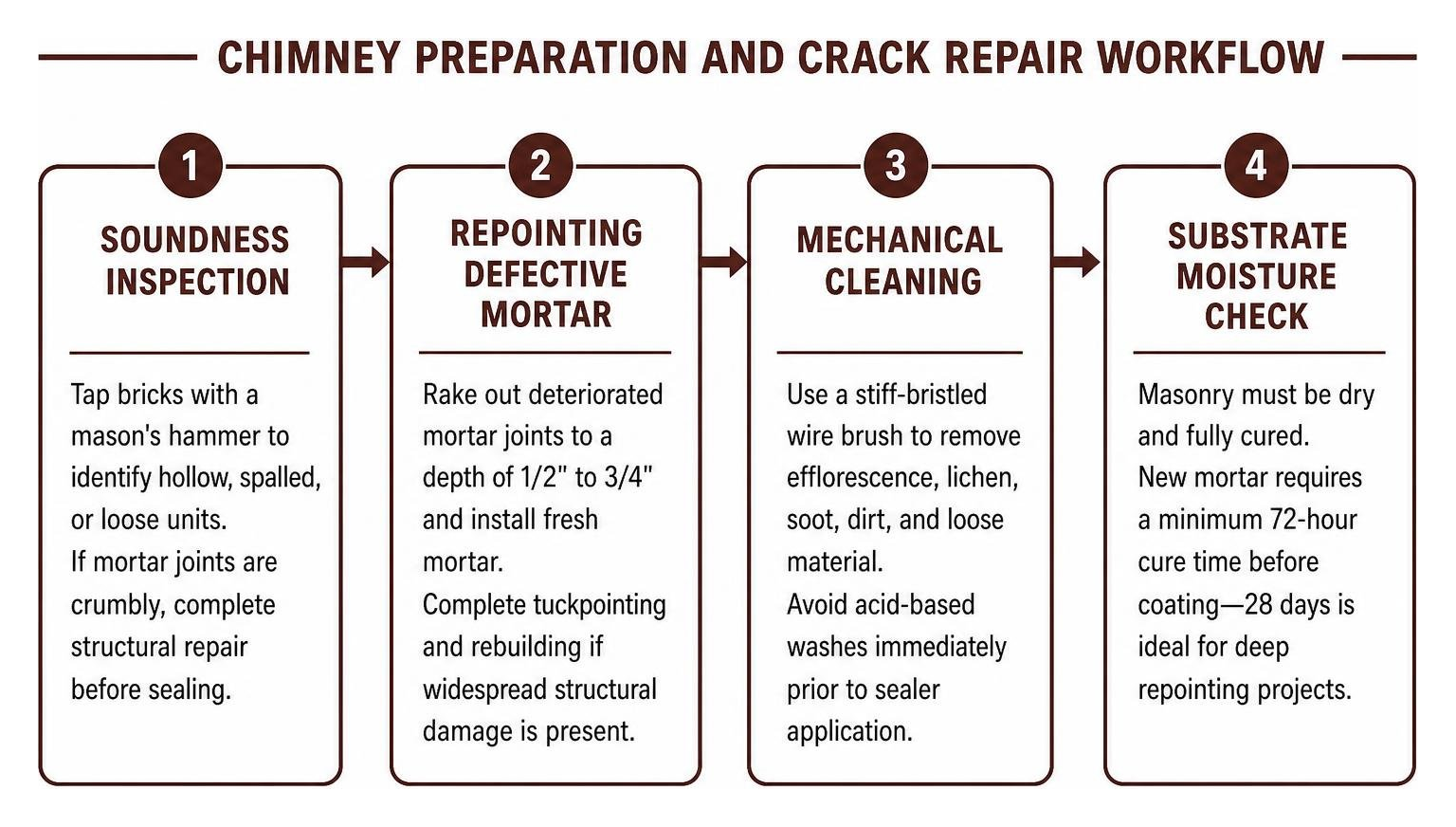
Before opening any container of waterproofing product, inspect the chimney from the roof deck to the crown:
- Soundness Inspection: Tap bricks lightly with a mason’s hammer to identify hollow, spalled, or loose units. If mortar joints are crumbly, deep structural repair must occur before sealing.
- Repointing Defective Mortar: Rake out deteriorated mortar joints to a depth of 1/2″ to 3/4″ and install fresh mortar. For chimneys exhibiting widespread structural damage or leaning shafts, complete necessary tuckpointing and chimney rebuilding prior to applying surface waterproofing.
- Mechanical Cleaning: Use a stiff-bristled wire brush to remove efflorescence, surface lichen, soot, dirt, and loose material. Avoid using acid-based washes immediately prior to sealer application, as residual acid disrupts the chemical bond of siloxanes and elastomeric resins.
- Substrate Moisture Check: Masonry must be dry and fully cured (new mortar requires a minimum 72-hour cure time before coating, though 28 days is ideal for deep repointing projects).
Surface Preparation and Applying Chimney Waterproofing Products
Once the underlying structure is clean, stable, and dry, follow this step-by-step application process:
Step 1: Environmental & Temperature Checks
Confirm that ambient air and surface temperatures are between 45°F and 95°F, with no forecast of freezing conditions within 24 hours. For solvent-based asphalt mastics, application can proceed at lower temperatures, though substrates below 40°F generally require a dedicated primer coat to maximize adhesion.
Step 2: Perimeter Masking
Apply heavy-duty duct tape around the top edge of the upper brick courses directly below the crown edge, as well as around the exposed clay flue tiles. Masking prevents messy drips on decorative brick and creates a crisp, professional termination line for your membrane.
Step 3: Crack Pre-Treatment
For crown coatings, fill wide structural fissures (cracks over 1/8″ wide) with patching cement or an approved elastomeric caulk. Allow the patch to take an initial set before applying the primary coating.
Step 4: Substrate Pre-Wetting (Elastomeric Crowns Only)
Lightly mist the dry concrete crown with water using a pump sprayer. A damp surface cools down the slab in warm weather, prevents the masonry from prematurely sucking moisture out of the coating, and promotes superior chemical adhesion. (Note: Do not mist surfaces when applying solvent-based sealers or flashing membranes).
Step 5: Product Application
- For Penetrating Repellents: Apply from the bottom of the chimney upward using a low-pressure chemical sprayer or heavy-nap roller, ensuring a 6- to 8-inch flood run-down on vertical brickwork to guarantee complete saturation.
- For Crown Coatings: Trowel or brush the material evenly over the top of the crown at a uniform thickness between 1/8″ and 1/4″ (maximum 1″ in low spots). Smooth the surface toward the edges to maintain positive slope away from flue liners.
- For Hybrid Flashing Sealants: Use a 3-inch disposable chip brush to work the hybrid coating directly into metal-to-brick joints, overlapping both surfaces by at least 2 to 3 inches.
Step 6: Tape Removal and Curing
Peel away all masking tape while the coating is still workable to avoid tearing the curing membrane. Protect the installation from freezing temperatures. Most elastomeric systems cure tack-free in 2 to 4 hours in warm weather, reaching full functional cure within 24 to 72 hours.
Frequently Asked Questions About Chimney Waterproofing
What is the difference between a film-forming sealer and a breathable water repellent?
A film-forming sealer (such as standard acrylics, polyurethane varnishes, or clear coats) covers the surface with a continuous plastic layer that blocks all pores. While this keeps rain out initially, it also traps internal humidity inside the brickwork. When trapped water freezes during cold weather, it expands, spalling the brick faces.
A breathable water repellent, like a water-based siloxane compound, lines the internal microscopic pores of the masonry without creating a film. Liquid water droplets are repelled at the exterior face due to surface tension, while internal water vapor moves through the open pores and evaporates into the atmosphere.
How often do chimney waterproofing treatments need to be reapplied?
High-grade siloxane water repellents and elastomeric crown coatings typically carry 10-year manufacturer warranties. In regions with severe freeze-thaw cycles, driving rain, or intense UV exposure, chimney structures should be visually inspected once a year. If water applied from a spray hose darkens the brickwork immediately rather than beading up, the repellent has worn down and should be reapplied.
Can waterproofing products fix existing masonry cracks and spalling?
Waterproofing products cannot repair deep structural failure. While elastomeric coatings bridge hairline fissures up to 1/8″ (and up to 1/4″ when paired with mesh) and can bond isolated spalled bricks, they cannot restore collapsed flues, crumbling core bricks, or settling foundations.
If bricks have lost their structural integrity, consult our team for comprehensive chimney services to rebuild the masonry before applying waterproof protection.
Conclusion
Protecting your chimney against water intrusion is an investment in the safety, beauty, and structural integrity of your home. By pairing the right waterproofing chemistry with the right surface—breathable siloxane repellents for vertical brick, elastomeric membranes for crowns, and hybrid moisture-cure sealants for roof flashing—you can prevent freeze-thaw damage, efflorescence, and interior water leaks.
Always make sure structural repairs, tuckpointing, and thorough cleaning are completed before applying sealants. If your chimney shows signs of loose bricks, deteriorated crowns, or failing flashing, contact the licensed specialists at PN Masonry. We provide comprehensive masonry rebuilding, flashing restoration, and professional sealing services for homeowners and commercial property managers throughout Cook County, Illinois.