
Block Wall Core Repair Starts With Reinforcement and Water Control
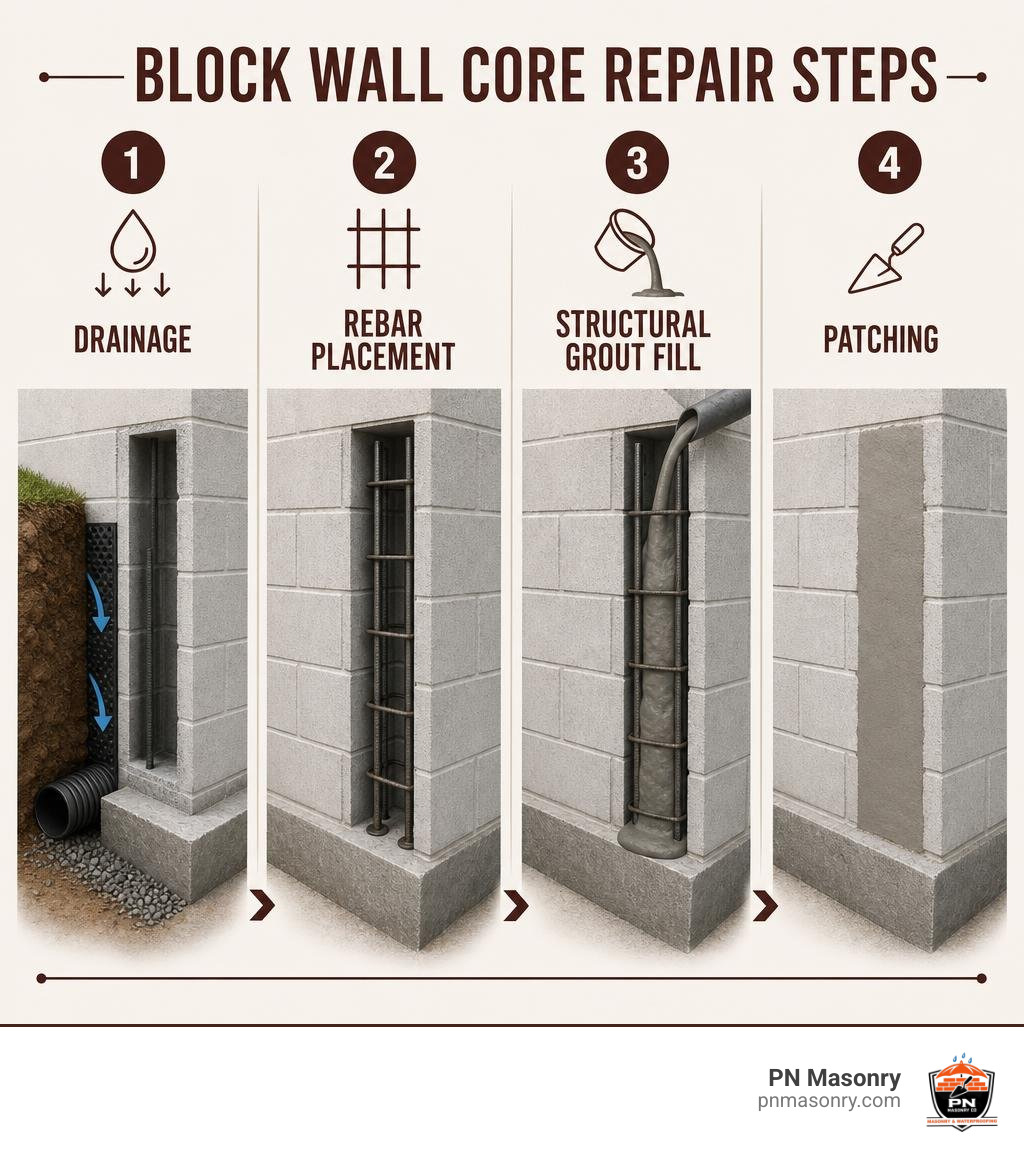
Block wall core repair restores strength by placing steel rebar in selected hollow CMU cells and filling those cells with flowable structural grout. Before filling anything, identify and reduce the water or soil pressure that caused the damage. Then clean the targeted cores, install rebar tied into the footing where the design requires it, grout the cells fully, and patch the access openings.
This repair can help stabilize a wall with early bowing, horizontal mortar-joint cracks, stair-step cracking, or water-related deterioration. It is not a cosmetic patch. Reinforced, grout-filled cells act like vertical columns inside a hollow block wall, improving its ability to resist lateral soil pressure.
If the wall is badly bowed, crushed, actively moving, or has major footing displacement, stop and get a qualified structural assessment before attempting repairs. Core filling can strengthen a repairable wall, but it cannot safely reverse every type of failure.
Understanding Hollow CMU Foundations and the Need for Block Wall Core Repair
Concrete masonry units (CMU) are standard building blocks for residential basements, retaining walls, and commercial structures. When laid, these blocks form hollow vertical chambers. While plain concrete blocks excel under compressive loads—handling vertical weight from floor joists and roof framing with ease—unreinforced hollow walls possess very low tensile strength.
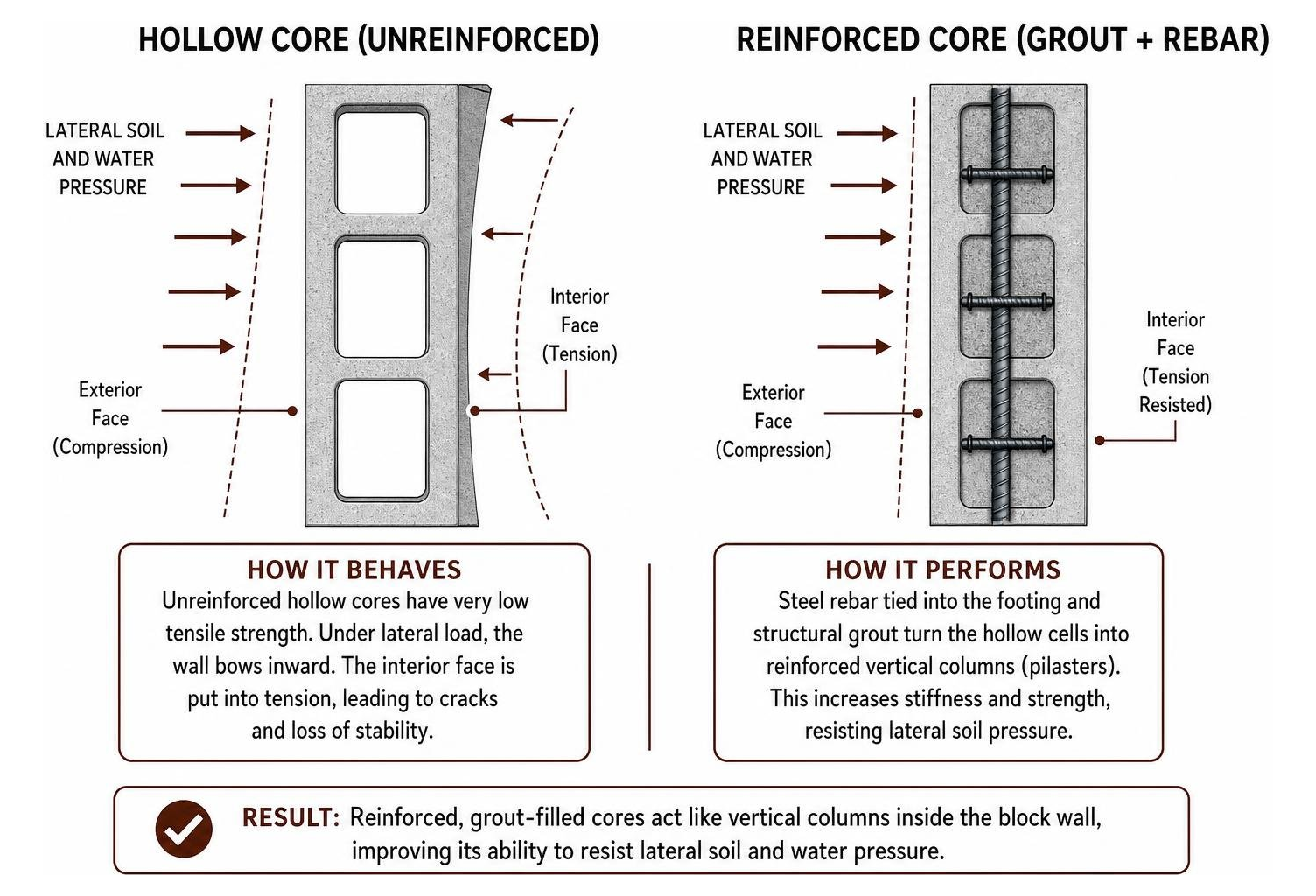
When soil and water press against the exterior face of an unreinforced block wall, the wall behaves like a vertical beam under a distributed lateral load. The exterior face goes into compression, while the interior face is pulled into tension. Because concrete cannot withstand high tension, the wall begins to deflect inward.
Without internal reinforcement, the neutral axis of the wall shifts, leading to micro-fissures that develop into severe structural cracks. Filling select hollow cores with steel and structural grout transforms hollow cells into reinforced vertical pilasters, significantly increasing stiffness and load transfer capacity.
Why Hollow Block Cores Fail Under Lateral Load
The main culprit behind failing block walls is lateral earth pressure amplified by moisture. Clay soils act like dense sponges; as they absorb water, they expand significantly and press against below-grade masonry. When heavy precipitation saturates the ground, hydrostatic pressure climbs rapidly.
Standard hollow masonry walls rely entirely on the tensile bond of mortar joints to resist these lateral forces. Once the pressure exceeds that bond strength:
- Horizontal mortar joints shear and crack under tension.
- Individual block courses shift inward.
- Hollow voids fill with trapped moisture, accelerating deterioration during winter freeze-thaw cycles (water expands roughly 9% upon freezing).
For property owners facing unstable subgrades or bowing basements, our specialized concrete block repair in Franklin Park, IL addresses structural movement before cracks compromise the building above.
Key Signs Your Wall Demands a Block Wall Core Repair
Catching masonry movement early prevents sudden structural failure. Visual cues usually reveal whether damage is superficial or a sign of internal core distress.
Horizontal cracking running along the middle mortar courses is a classic warning sign of high inward soil pressure. Stair-step cracks near corners show differential settlement or uneven lateral loading. When you notice persistent efflorescence—powdery white mineral salts left behind as water evaporates through masonry—it indicates continuous moisture travel through the hollow cores.
Essential Materials and Tools for Structural Grouting and Rebar Reinforcement
Executing a durable core fill requires dedicated structural tools rather than basic trowels:
- Diamond-blade masonry saws & angle grinders: Used for cutting precise vertical access slots and bottom cleanout ports without vibrating adjacent joints loose.
- Heavy-duty rotary hammer drill: For drilling clean holes into footings and masonry webs.
- Core cleanout tools & compressed air: Scrapers, vacuum wands, and high-pressure air nozzles to clear mortar fins and dropped debris from the base of the cell.
- Grout delivery pump or funnel hopper: For placing high-slump grout into cores smoothly without air pockets.
- Mechanical pencil vibrator: Essential for consolidating grout around embedded steel.
- PPE: Heavy nitrile gloves, dust mask/respirator (N95 or better for silica dust), safety glasses, and hearing protection.
Structural Grout vs Standard Masonry Mortar
A common mistake in DIY foundation fixes is using standard Type S or Type N mortar to fill block cores. Mortar is designed with high stickiness (cohesiveness) to hold blocks during laying, but it lacks the flowability, aggregate size, and slump needed to fill deep vertical chambers.
Structural grout mixed to ASTM C476 standards has high fluid slump (often 8 to 11 inches) and contains non-shrink additives. This fluidity allows it to encapsulate reinforcing steel completely, bind directly to the internal block webs, and fill voids without creating air pockets.
Reinforcing Elements: Steel Rebar, Ties, and Epoxies
The backbone of internal reinforcement is deformed Grade 60 steel rebar, typically #4 (1/2-inch) or #5 (5/8-inch) diameter rods. Steel provides the tensile strength that masonry lacks.
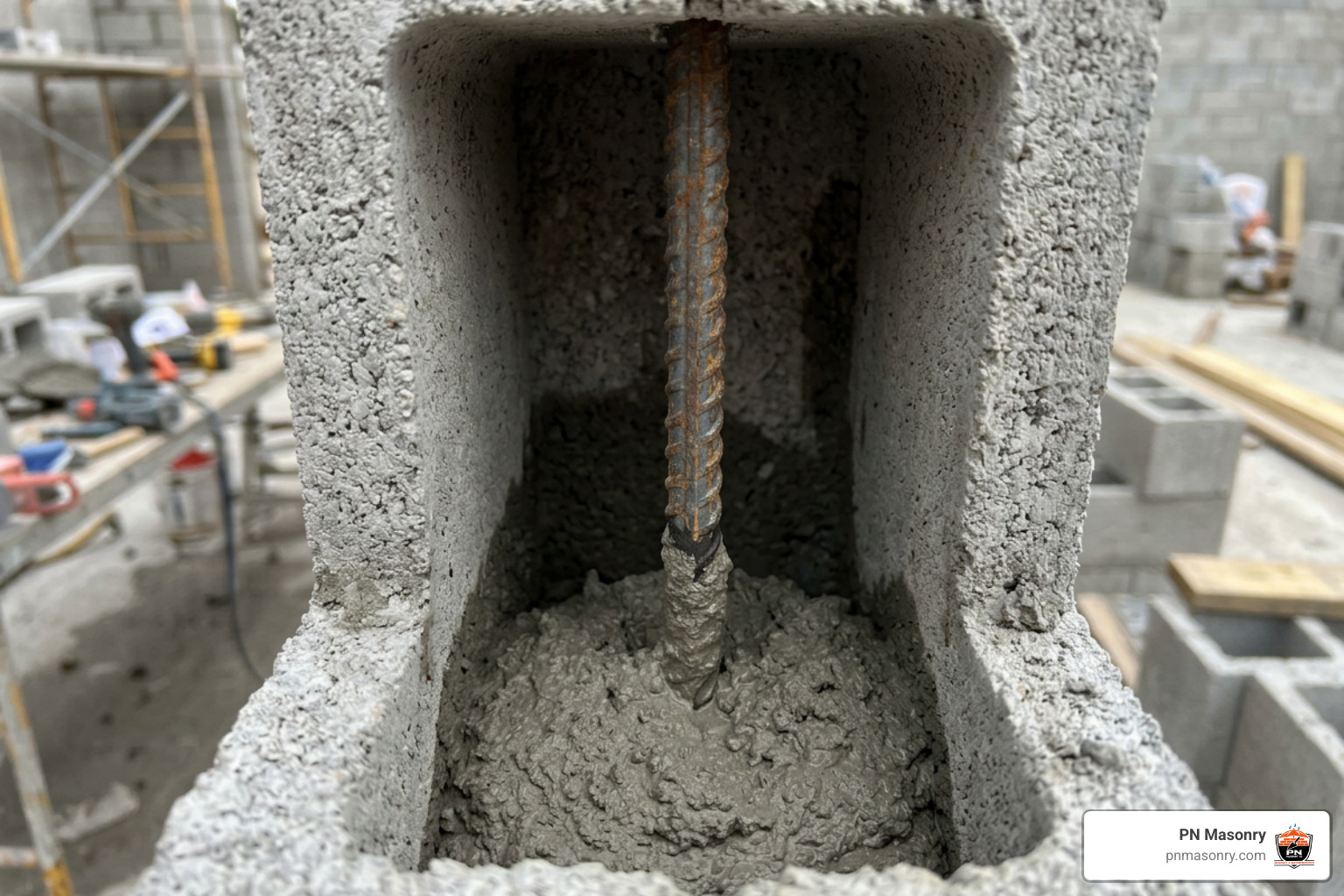
To resist lateral bending, steel must be positioned away from the neutral axis toward the interior tension face of the wall. Using rebar centering clips ensures the metal stays suspended in the center of the flowable grout column rather than resting against the internal block wall.
High-strength epoxy resins anchor the bottom dowels into the concrete footing. Lab testing on epoxy-bonded structural assemblies demonstrates shear strengths reaching 1,480 psi, with total failure loads exceeding 30,000 pounds. As detailed in the Method for reinforcing hollow concrete block walls (US Patent 6655107), injecting structural grout alongside positioned vertical rebar restores integrity to hollow walls subjected to heavy soil loads.
Step-by-Step Guide to Executing a Block Wall Core Repair
Reinforcement intervals are typically planned every 32 to 48 inches along the wall, focusing heavily on sections showing signs of deflection.
Step 1: Accessing the Hollow Cells (Top-Down or Cut-Slot Method)
Before placing rebar or grout, you need clear access to the hollow chambers:
- Top-Down Method: If the top of the foundation wall is unobstructed (such as during construction or where floor joists run parallel), grout can be poured directly into top openings.
- Cut-Slot Method (Low-Clearance / Basement Interiors): When floor joists block top access, use a diamond-blade saw to cut vertical face slots (approximately 4 to 6 inches wide) or access ports in the top course of the target block cores.
- Cut Cleanout Openings: Cut a 4×4-inch cleanout window at the very bottom course of every core to be filled. Clear out accumulated mortar droppings and debris using a chisel, shop vacuum, and compressed air. Grout cannot bond to the footing if loose debris sits at the base.
Step 2: Placing Vertical Rebar and Centering
- Drill Footing Dowels: Drill a hole into the exposed concrete footing through the bottom cleanout opening. Clean the hole thoroughly and inject structural anchoring epoxy, then drive a steel dowel pin into place.
- Insert Vertical Rebar: Slide the full-length Grade 60 rebar down the hollow cell from the top access port.
- Lap Splice: Secure the vertical bar to the footing dowel using heavy steel tie wire, ensuring a minimum lap splice length (typically 40 to 48 times the bar diameter).
- Install Centering Guides: Attach plastic or wire centralizers to the rebar to maintain proper spacing within the core, keeping it positioned to absorb tension forces.
Step 3: Pumping and Consolidating Flowable Structural Grout
- Seal Cleanout Ports: Form and seal the bottom cleanout ports using temporary formwork or fast-setting mortar patches reinforced with masonry screws.
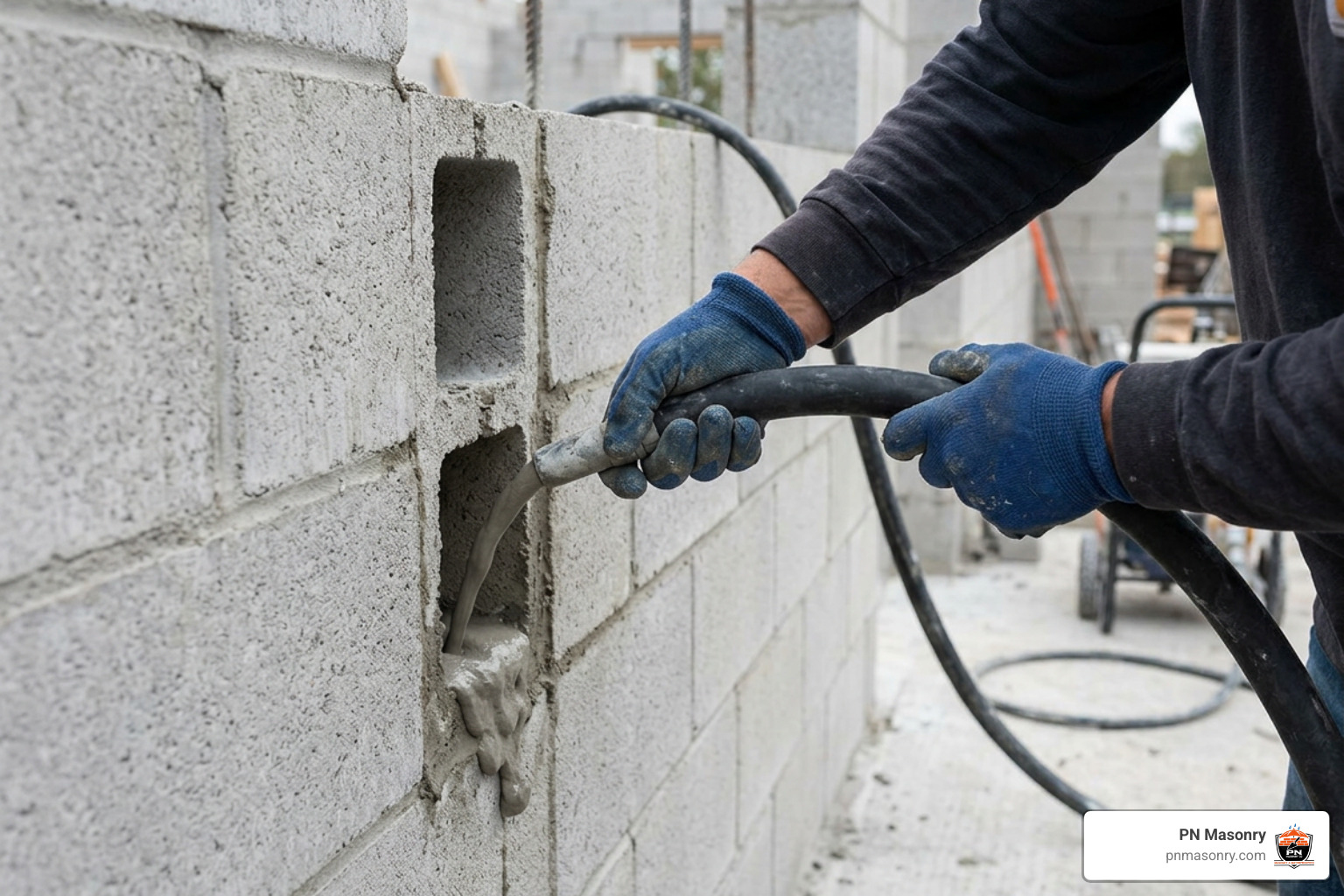
- Pump Grout: Deliver flowable, high-slump structural grout into the top openings. For full-height walls, place grout in continuous lifts (usually 4 to 5 feet per lift) to prevent excessive hydrostatic pressure from bursting the lower block faces.
- Mechanical Consolidation: Insert a narrow pencil vibrator into the grout column to release trapped air pockets and ensure complete coverage around the rebar. Avoid over-vibrating, which can segregate aggregate.
- Patch and Finish: Strike off the grout flush at the access points. Once cured, patch the masonry face cuts with polymer-modified repair mortar.
When you need turn-key structural masonry updates completed with dedicated pumping equipment, our concrete contractor services in Franklin Park provide complete project execution from layout to final cure.
Addressing Hydrostatic Pressure and Water Management Around the Core
Filling block cores adds internal strength, but it does not remove the water driving against your foundation from the outside. If exterior hydrostatic pressure is ignored, groundwater will continue pushing against un-grouted cells and mortar seams.
Exterior Drainage and Waterproofing Defenses
To preserve your masonry long term, pair internal core stabilization with proper water management:
- Grade and Downspouts: Ensure surface soil slopes away from the foundation at a minimum 5% pitch, and route roof downspout extensions at least 10 feet away.
- Exterior Waterproofing & Dimple Boards: Excavating soil and applying elastomeric membranes creates an impermeable seal, while dimple drainage boards relieve hydrostatic pressure by channeling water downward.
- Interior Weep Holes: For walls with persistent interior moisture, drilling weep holes into the bottom course of hollow blocks allows trapped water to drain into an interior sub-floor French drain.
- Breathable Sealers: Treating exterior and above-grade masonry with deep-penetrating silane-siloxane treatments blocks liquid water while allowing water vapor to escape. For comprehensive moisture protection, explore our brick and block sealing and waterproofing solutions.
Core Filling and Masonry Reinforcement Approaches
Reinforcing hollow block walls can involve several structural techniques depending on the level of inward movement and site conditions.
In many residential basements, combining targeted core fills with external water management provides a balanced, long-lasting fix. In situations with localized deflection, homeowners often review solutions like the DRICORE™ PRO Concrete Repair carbon fiber reinforcement kit or follow practical field tips from guides on how to repair a block wall from pushing in and how to repair crumbling concrete block retaining walls.
Frequently Asked Questions About Block Wall Reinforcement
Can core filling be completed entirely from inside a basement?
Yes. When floor joists, ductwork, or subflooring prevent top-down pouring, core filling can be done from the interior. We cut vertical access slots in the top block course of each selected core, insert segmented rebar using structural lap splices, and pump flowable grout using specialized low-clearance grout hoses.
Cleanout windows cut into the base ensure all debris is cleared before pumping, ensuring a solid connection between the footing and the top of the wall.
What common mistakes ruin a block wall core fill?
The four most frequent mistakes during core grouting are:
- Using Stiff Mortar: Standard masonry mortar creates air pockets and bridges across narrow voids, leaving large sections of rebar exposed to moisture.
- Skipping the Cleanout Ports: Mortar droppings naturally accumulate at the bottom of hollow block walls during construction. If not cleaned out, grout cannot reach or bond with the concrete footing.
- Omitting Footing Dowels: Placing rebar in a core without anchoring it into the footing creates a floating column that can pivot under lateral soil pressure.
- Neglecting Drainage: Reinforcing a wall without fixing downspouts, surface grading, or subsurface drainage leaves hydrostatic pressure unresolved.
When is a block wall beyond repair and needing total replacement?
Core filling is an effective way to strengthen and stabilize compromised walls, but it cannot restore a collapsed structure. A block wall is generally considered beyond repair if:
- Total inward wall deflection exceeds 25% to 33% of the block thickness (e.g., more than 2 to 2.5 inches on an 8-inch CMU wall).
- The lowest course of block has sheared cleanly off the foundation footing.
- Face shells on multiple block courses are crushed, cracked through, or crumbling under vertical loads.
- The concrete footing underneath has cracked, settled, or rotated significantly.
In these situations, total structural replacement is the only safe path forward.
Conclusion
Hollow CMU walls are vulnerable to lateral earth pressure and moisture issues. By clearing debris from selected hollow cores, securing vertical steel rebar to the footing, and pumping flowable structural grout, you create strong internal columns that restore rigidity and stop wall movement.
At PN Masonry, we bring practical experience to complex masonry challenges across Cook County, Illinois. Whether you need structural core grouting, foundation crack repairs, or moisture protection for residential or commercial properties, our team provides straightforward assessments and dependable service.
Ready to restore your foundation? Contact PN Masonry today to schedule an on-site structural masonry inspection.