
Chemistry and Types of Masonry Water Repellent Formulations
To choose the best masonry water repellent, match the active chemistry to your substrate porosity and exposure: select deep-penetrating silanes for dense concrete and high-density stone, larger-molecule siloxanes or silane/siloxane blends for porous clay brick and CMU block, and specialized breathable formulations for calcareous limestone or marble. Choosing a penetrating, vapor-permeable water repellent rather than a film-forming coating prevents freeze-thaw spalling by allowing internal vapor to escape while wind-driven rain beads up and rolls off.
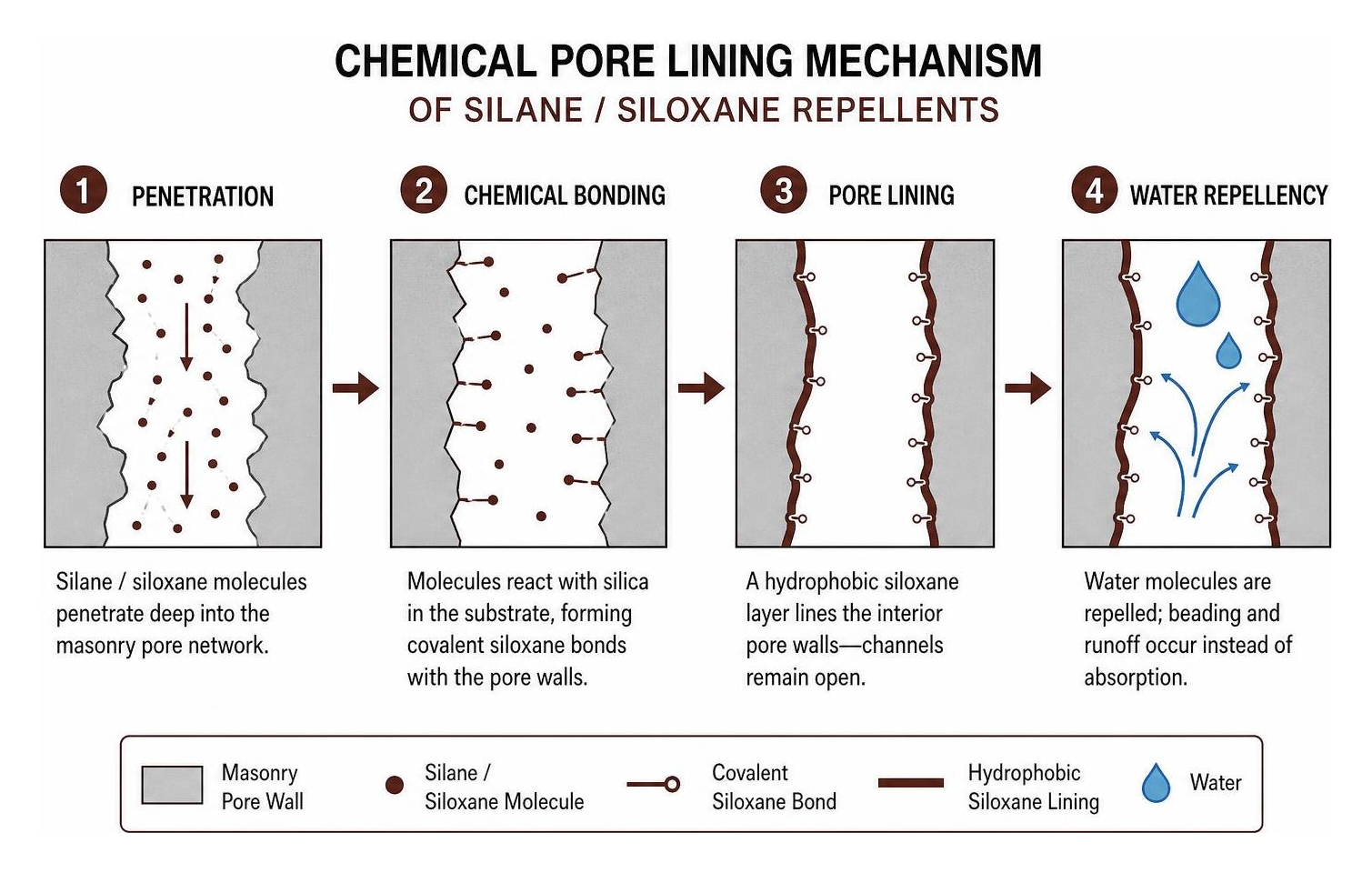
Masonry materials are naturally porous networks of microscopic capillaries. When wind-driven rain hits an untreated wall, capillary suction pulls liquid deep into the substrate. Masonry water repellents solve this problem by chemically modifying the surface tension within these pores. Instead of filling or capping the void, the chemistry lines the interior pore walls, altering the contact angle between liquid water and the substrate.
Several active chemistries exist in modern protective treatments:
- Silanes: Composed of tiny molecular structures, silanes offer deep penetration into dense substrates like poured concrete, high-density brick, and precast stone. Because they are monomeric, silanes react chemically with silica in the masonry (forming covalent siloxane bonds) and evaporate their carrier, leaving no visible residue.
- Siloxanes: Possessing a larger oligomeric molecular structure, siloxanes excel on highly porous substrates such as CMU (concrete masonry units), standard clay brick, and coarse mortar. They provide excellent water repellency near the surface and bond tenaciously to both neutral and alkaline substrates.
- Silane/Siloxane Blends: Combining the deep-penetration properties of small silane molecules with the rapid surface-beading performance of larger siloxane polymers creates a balanced, highly versatile water repellent for mixed-masonry assemblies.
- Siliconates (e.g., Potassium Methyl Siliconate): Water-soluble treatments that react with atmospheric carbon dioxide and the substrate to form an insoluble silicone resin network. They are cost-effective but require careful application to prevent white residue on dark brick.
- Fluoropolymers: Advanced formulations that provide oleophobic (oil-repellent) as well as hydrophobic characteristics, making them suitable for areas exposed to vehicle fluids, food spills, or heavy urban pollution.
Reviewing technical data on siloxane systems shows that these treatments significantly lower the capillary water absorption coefficient ($W_{24}$) below 0.1 $\text{kg}/(\text{m}^2\cdot\text{h}^{0.5})$—classifying the treated surface as low absorption under international standards (UNI EN 1062-3) while keeping capillary channels unobstructed.
Penetrating Masonry Water Repellent vs Film-Forming Coatings
The fundamental decision when protecting a building envelope is choosing between a penetrating water repellent and a film-forming coating.
Film-forming coatings—such as elastomeric paints, 100% acrylics, and standard masonry sealers—create a continuous, solid barrier over the exterior surface. While they block bulk water ingress, they also dramatically restrict vapor transmission. If moisture penetrates the wall assembly from interior humidity, rising damp, roof flashings, or hairline joint defects, it becomes trapped behind the impermeable film. During seasonal temperature swings, that trapped water turns into vapor under solar drive, creating hydraulic pressure that blisters, cracks, and peels the coating, frequently taking the face of the brick with it.
By contrast, penetrating water repellents soak into the capillary network (often up to 1/4 inch or roughly 12 mm depending on porosity and active chemistry). The internal pore structure remains open to the passage of air and water vapor.
| Performance Attribute | Penetrating Silane/Siloxane Repellent | Film-Forming Masonry Paint / Coating |
|---|---|---|
| Mechanism of Action | Chemically lines internal capillary pores | Builds a continuous physical surface film |
| Vapor Permeability | High (Highly transpirant, $s_D < 0.14\text{ m}$) | Very Low to Low (Semi-impermeable, perm $< 1$) |
| Surface Appearance | Invisible; no change in sheen or texture | Opaque, colored, or high-gloss sheen |
| Freeze-Thaw Spall Risk | Extremely Low (Trapped vapor diffuses out) | High (Trapped water freezes behind the film) |
| Blistering & Peeling | Does not blister, crack, or peel | Prone to peeling when water enters from behind |
| Typical Standards | ASTM E514, EN 1504-2, UNI EN ISO 7783-2 | ASTM D6532, ASTM C67, CSI MasterFormat 09 91 |
| Maintenance Profile | Simple re-spray after service life | Requires scraping, chemical stripping, repainting |
Calcareous and Dense Substrate Treatments
Not all masonry behaves the same way chemically. Silica-rich substrates like standard clay brick, granite, and sandstone readily bond with standard silane-siloxane treatments. However, calcareous stones—such as limestone, marble, and travertine—are composed primarily of calcium carbonate ($\text{CaCO}_3$) and lack the free silica required for standard silane cross-linking.
When protecting historical limestone structures or architectural marble facades, specialized breathable siloxane treatments engineered for calcareous masonry are required. These modified formulations achieve deep molecular penetration without altering the natural, non-glossy appearance of historic stone.
Testing reveals that tailored treatments reduce water absorption by up to 99% on brick (ASTM C 67), over 95% on CMU (ASTM C 140), and roughly 79% on dense concrete (ASTM D 6532). Simultaneously, treating calcareous stone protects against biological staining, acid rain erosion, and atmospheric sulfate attack without locking in moisture.
Selecting the Right Repellent for Your Project Conditions
Choosing the correct product formulation requires evaluating the substrate orientation, the source of moisture, and environmental exposure.
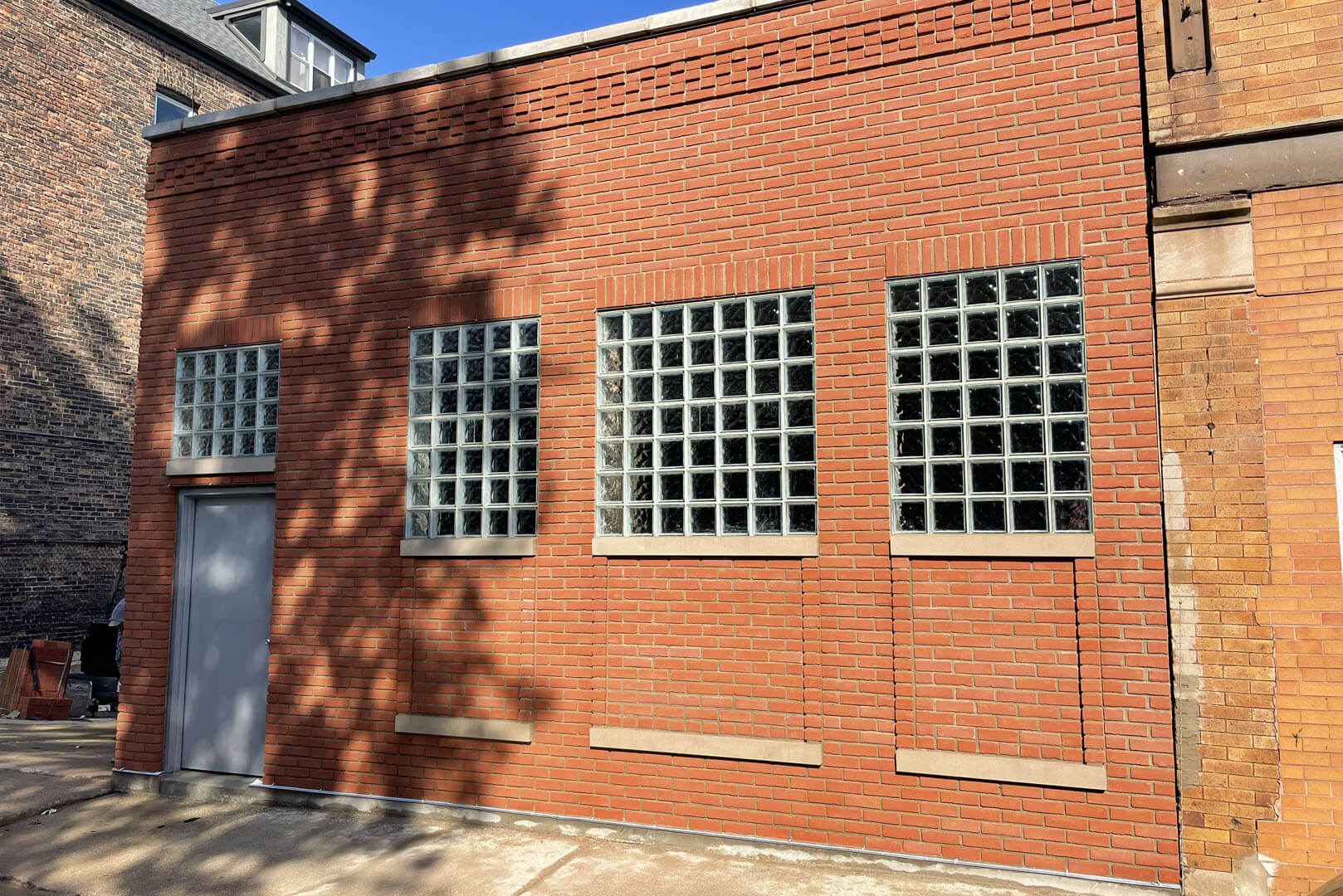
- Vertical Above-Grade Masonry: Exterior building facades, chimneys, parapet walls, and split-face CMU block require vapor-permeable penetrating treatments. Wind-driven rain strikes the facade and sheets off, while interior humidity escapes naturally. For projects requiring comprehensive exterior envelope care, our brick and block sealing services provide the exact saturation rates needed for lasting weatherproofing.
- Horizontal Flatwork: Patios, concrete driveways, stone pool decks, and sidewalks face ponding water, heavy pedestrian or vehicular traffic, abrasion, and direct application of de-icing salts. These surfaces require specialized silane-based sealers designed to resist abrasion and salt pitting. If your flatwork is showing signs of winter scaling, explore our dedicated concrete sealing in Franklin Park, IL to protect horizontal slabs against freeze-thaw damage.
- Below-Grade and Hydrostatic Pressure Limitations: A penetrating water repellent applied to an interior basement wall will not stop active hydrostatic groundwater pressure pushing through from the outside. Penetrating treatments repel gravity-fed and wind-driven water, but they cannot hold back standing water tables under continuous hydraulic head pressure. Below-grade negative-side leaks require heavy cementitious barrier systems, negative-side hydraulic plugs, or exterior excavation and drainage membranes.
Interior vs Exterior Masonry Environments
When working inside occupied homes or commercial facilities—such as exposed interior brick lofts or historic stone basements—environmental safety and indoor air quality take priority.
- Water-Based Emulsions: These products contain negligible or zero Volatile Organic Compounds (VOCs), emit almost no odor, and are non-flammable. They clean up quickly with plain soap and water, making them ideal for residential interiors, enclosed spaces, and environmentally sensitive projects. They are completely safe around family pets, ornamental landscaping, and household plants once dry.
- Solvent-Based Penetrants: Utilizing mineral spirits or specialized hydrocarbon carriers, solvent formulas provide slightly deeper penetration on extremely dense or low-porosity stones and can be applied in cooler ambient temperatures (down to 40°F / 4°C). However, solvent-based carriers carry distinct flash points (e.g., 110°F / 43°C) and higher VOC levels (often exceeding 700 g/L unless formulated with exempt solvents). They require robust mechanical ventilation, respirator protection, explosion-proof equipment, and strict isolation from open flames or pilot lights.
Under modern EPA Architectural and Industrial Maintenance (AIM) regulations and local regional guidelines in Illinois, contractors and property managers must ensure all applied formulations comply with strict clean-air VOC limits.
Substrate Porosity and Reapplication Lifespans
The longevity of a water-repellent treatment depends directly on the porosity of the substrate, the quality of the active solids, and its exposure to sun and wear:
- Standard Clay Brick & Mortar: Vertical brick veneer typically retains water repellency for 5 to 10 years when treated with quality siloxanes. High-performance deep-penetrating creams can deliver functional service lives exceeding 20 to 25 years.
- Split-Face CMU & Concrete Block: Highly porous cinder and concrete masonry units absorb large volumes of fluid. A heavy saturating flood coat provides 5 to 7 years of reliable barrier protection before reapplication is necessary.
- Horizontal Concrete & Pavers: Because horizontal surfaces experience direct ultraviolet radiation, abrasive foot traffic, snowplowing, and standing puddles, horizontal treatments typically require maintenance every 2 to 3 years.
- Natural Sandstone & Limestone: Porous natural stone generally maintains active protection for 5 to 7 years on vertical elevations before requiring re-treatment.
Substrate Preparation and Surface Repair Standards
Applying a high-end water repellent over a dirty, cracked, or crumbling wall locks in existing contamination and guarantees early water intrusion through voids. Surface preparation represents 80% of any successful masonry preservation project.
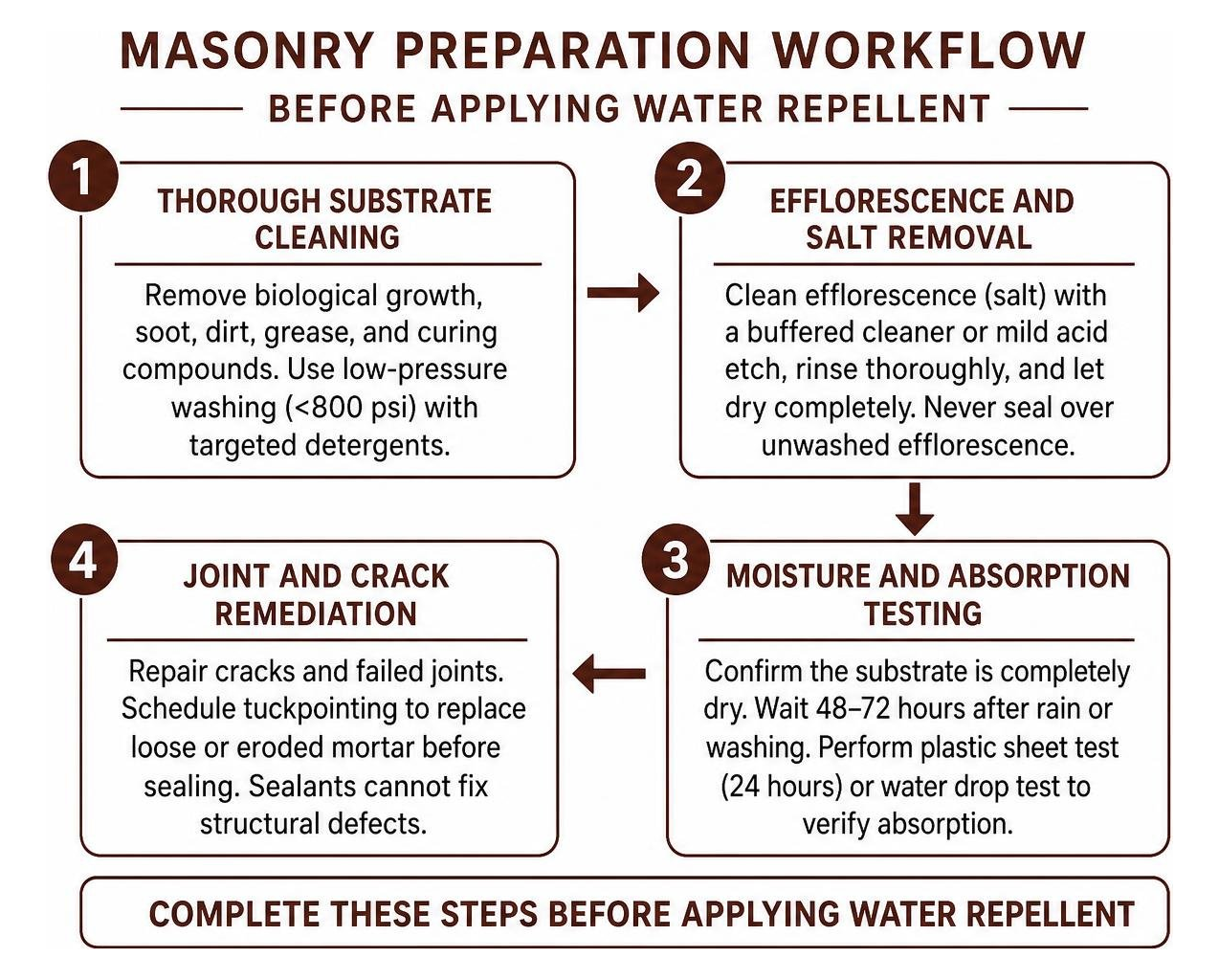
Before opening a pail of repellent, complete these essential surface preparation steps:
- Thorough Substrate Cleaning: Remove all biological growth (moss, algae, mold), atmospheric soot, dirt, grease, and curing compounds. Low-pressure washing (under 800 psi) with targeted detergents is preferred. Never blast historic brick with high pressure, as it strips the hard outer fire-skin of the clay and exposes the soft, hyper-porous core.
- Efflorescence and Salt Removal: Efflorescence—the powdery white salt crust that appears on damp masonry—must be fully cleaned before sealing. Efflorescence occurs when water dissolves natural salts inside the brick or mortar, carries them to the surface, and leaves the mineral deposits behind as it evaporates. Treat the wall with a dedicated, buffered efflorescence cleaner or mild acid etch, rinse thoroughly, and let it dry completely. Sealing over unwashed efflorescence traps salts under the surface, causing sub-surface crystallization (crypto-efflorescence) that destroys the masonry face.
- Moisture and Absorption Testing: The substrate must be completely dry. As a field test, wait 48 to 72 hours after rain or washing, then tape a 12×12 inch sheet of clear plastic or heavy foil to the wall for 24 hours. If condensation appears on the underside of the plastic, the wall still holds internal water and cannot absorb the repellent. You can also perform a simple water drop test: splash a few drops of clean water onto the brick. If the water darkens the surface and absorbs immediately, the wall is ready for treatment. If it beads, a previous sealer or paint is blocking access.
- Joint and Crack Remediation: Liquid water repellents can bridge microscopic hairline shrinkage fissures (up to 0.02 inches / 0.5 mm), but they cannot seal structural cracks, failed expansion joints, or missing mortar. If your masonry has cracked, loose, or eroded joints, schedule professional tuckpointing to grind out decayed mortar and pack fresh, matched mortar into the assembly before sealing. For older structures exhibiting widespread brick degradation, comprehensive brick facade restoration in Franklin Park, IL ensures that underlying structural stability is restored prior to final weatherproofing.
Application Best Practices and Field Techniques
Applying a masonry water repellent is not like painting an accent wall. It is a chemical saturation process that relies on fluid mechanics to achieve deep absorption.
- Application Equipment: For large vertical facades, use a low-pressure commercial pump sprayer or an airless spray rig set to low pressure (under 30 psi) equipped with a wide fan tip (such as .035 to .051 inch orifice). Low pressure produces large droplets and avoids atomization, preventing drifting overspray and uneven coverage. For small residential details, chimneys, or touch-ups, natural-bristle masonry brushes or 3/8-inch nap rollers can be used, though spray application provides superior penetration into recessed mortar joints.
- Environmental Weather Windows: Apply treatments only when ambient air and surface temperatures stay between 40°F and 90°F (4°C to 32°C) for at least 24 hours before and after application. Never apply over frozen masonry, in direct intense midday sunlight (which flashes off the carrier before deep absorption occurs), or when rain is forecast within 12 to 24 hours.
- Coverage Calculation: Product coverage rates vary dramatically based on the porosity and texture of the substrate:
- Smooth Architectural Brick: 150 – 250 sq. ft. per gallon
- Porous Split-Face Concrete Block (CMU): 50 – 100 sq. ft. per gallon
- Dense Concrete Flatwork: 200 – 300 sq. ft. per gallon
- Rough Sandstone / Coarse Stone: 75 – 150 sq. ft. per gallon
For large commercial structures or multi-unit residential communities, partner with our team for full-scale building restoration services to ensure even coverage across high-elevation elevations.
How to Apply a Masonry Water Repellent Step-by-Step

Follow this field-tested procedure to ensure maximum chemical bonding and even, streak-free water resistance:
- Mask Adjacent Surfaces: Cover and protect all non-masonry surfaces. Glass windows, aluminum frames, painted trim, asphalt shingles, and ornamental plantings must be masked using polyethylene plastic and drop cloths. Silane and siloxane overspray can etch glass and leave stubborn chemical films on polished metals.
- Execute the Flood Coat from the Bottom Up (or Top Down per spec): For vertical walls, apply a continuous saturating flood coat. Start at the top of a workable vertical section and move horizontally across, allowing a steady 6- to 8-inch fluid rundown of chemical to cascade down the face of the brick below the spray pattern. This continuous sheet of fluid feeds the open pores and ensures complete coverage across mortar recesses.
- Back-Roll Mortar Pockets: Follow immediately behind the spray technician with a clean paint roller to distribute pooled liquid, eliminate heavy drips, and drive the fluid into irregular textured voids.
- Apply Wet-on-Wet Second Coat (If Required): Highly porous surfaces like CMU block or lightweight brick require a second coat. Apply this second application “wet-on-wet” within 10 to 20 minutes of the first coat, while the substrate is still damp from the carrier. Once the initial coat cures and establishes hydrophobic properties, the wall will repel subsequent attempts to apply product!
- Curing and Clean-Up: Allow the wall to air-dry. Most water-based siloxane formulas become touch-dry within 1 to 2 hours, allow light foot traffic on flatwork in 2 to 4 hours, and achieve full hydrophobic cross-linking within 72 hours. Clean all equipment immediately with warm soapy water (for water-based products) or appropriate mineral spirits (for solvent-based lines).
Frequently Asked Questions About Masonry Protection
Will a water repellent alter the color or texture of brick and stone?
High-quality penetrating silanes and siloxanes do not change the natural color, texture, or flat sheen of the masonry. Because they work below the surface within the pore structure rather than forming a top-layer plastic film, the wall maintains its original appearance.
Very dense or dark stone surfaces may exhibit a very slight, temporary darkening immediately after application, but this dissipates as the carrier evaporates. We always recommend applying a test patch in an inconspicuous area (measuring at least 4×4 feet) to confirm visual compatibility before treating entire elevations.
Can water repellents be applied over previously painted or sealed surfaces?
No. Penetrating water repellents require open, porous capillary channels to absorb into the substrate. If a wall has been coated with latex paint, acrylic sealer, or elastomeric coatings, the repellent cannot penetrate. It will puddle on the surface, dry into an unsightly patchy film, and wash away in the next rainstorm.
All old paints, non-breathable sealers, and waterproofing films must be mechanically abraded or chemically stripped down to bare, porous masonry before applying a penetrating treatment.
How do repellents prevent efflorescence and freeze-thaw spalling?
Freeze-thaw spalling happens when liquid water fills internal pores and freezes during sub-zero winter temperatures. Because water expands roughly 9% in volume upon freezing, it exerts immense hydraulic pressure (up to several thousand psi) against the internal walls of the brick, popping off the brick face.
Penetrating repellents line the pores to stop bulk liquid water from entering from the outside while leaving the capillary network open for internal moisture to evaporate harmlessly.
By keeping the wall dry, repellents also stop the internal water flow required to dissolve subterranean minerals, keeping efflorescence salts safely locked inside the masonry.
Conclusion
Protecting building facades and hardscaping from water damage requires balancing moisture resistance with essential vapor breathability. Relying on thick, non-breathable paints or neglecting deteriorating mortar joints leads to internal moisture buildup, spalled brick, structural movement, and expensive structural repairs.
By selecting the right penetrating silane, siloxane, or stone treatment, preparing surfaces thoroughly, and following professional saturation standards, you create a long-lasting, invisible barrier against rain, freeze-thaw cycles, and de-icing chemicals.
As a full-service masonry contractor, our crew at PN Masonry handles everything from historical brick restoration and precision tuckpointing to large-scale commercial block sealing throughout Cook County, Illinois. Whether you manage a commercial facility or want to protect your home’s exterior, connect with us through our expert masonry waterproofing solutions today for an on-site evaluation and long-term protection plan.